Start with the smallest amount in the formula
A scale that handles a mixing bowl comfortably may still be a poor match for a very small ingredient amount. Before choosing a scale or reducing a recipe, write down the smallest quantity you need to weigh. Keep that number beside the total batch and the vessel you intend to use.
For an arithmetic example, an ingredient at 0.4% of flour weighs 2 g when the flour is 500 g. At 150 g flour, the same proportion is 0.6 g. The formula has scaled correctly, but the measuring task has changed. These figures illustrate the calculation; they are not a yeast recommendation or a complete recipe.
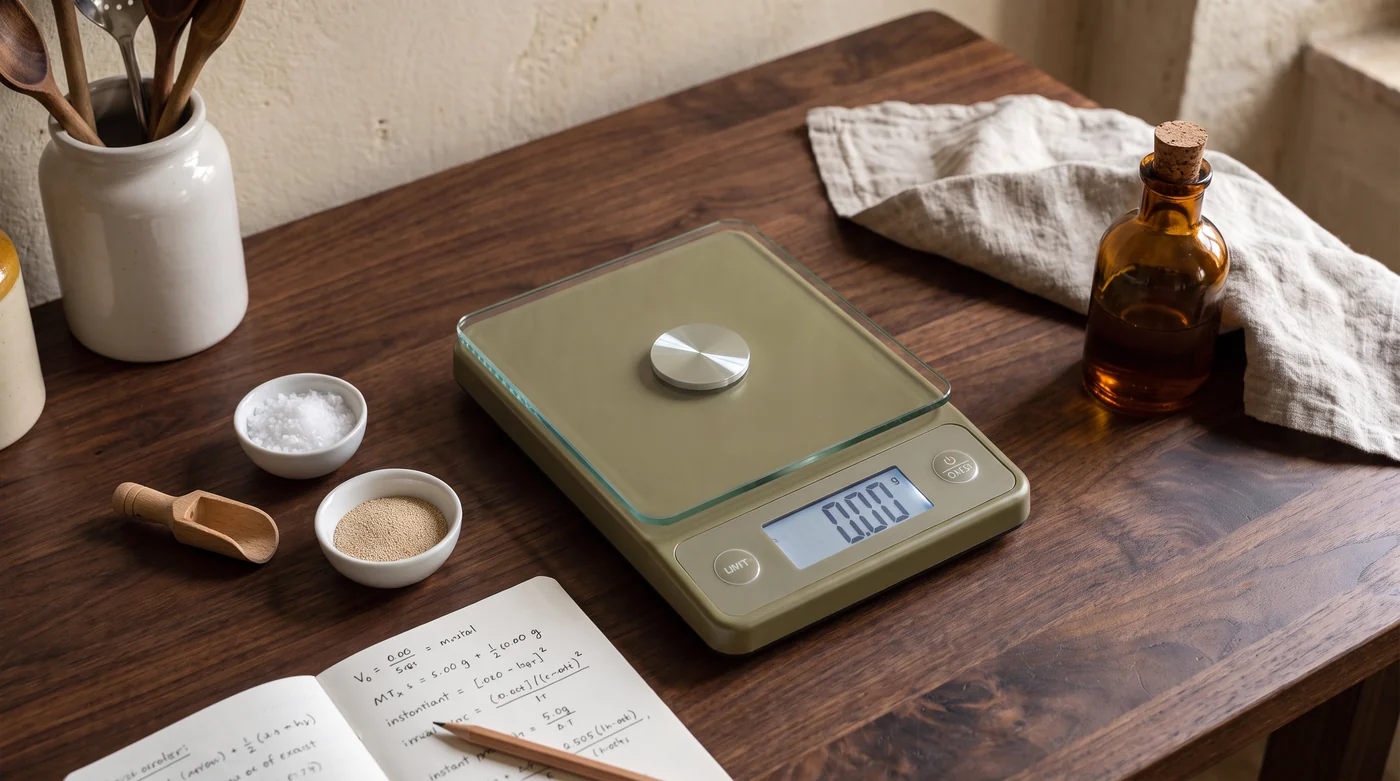
A whole-gram display cannot show 0.6 g as 0.6 g. That is worth noticing before mixing begins. It does not tell us exactly how a particular scale will respond while an ingredient is added, and it does not establish the actual mass behind its displayed number.
Display resolution is not an accuracy verdict
Resolution describes the steps the display can show. A display that advances in 1 g steps presents less detail than one that can show 0.1 g steps. Accuracy concerns how closely the indication represents the quantity being measured under the stated conditions. Reading an extra decimal place is not, by itself, evidence of a smaller measurement error.
NIST’s weighing guidance distinguishes the displayed scale division from the verification division used in the classification of regulated weighing instruments. That technical framework is not a certification of the household scales discussed here. Its useful lesson for this comparison is to avoid treating the number of visible digits as a complete performance specification.
Look for separate manufacturer statements about display increments, accuracy, range and operating conditions. If a listing supplies only the increments, retain the missing information as missing. Do not silently convert a 0.1 g display specification into an accuracy claim of plus or minus 0.1 g.
Read two manufacturer examples carefully
OXO describes its 11 lb Stainless Steel Food Scale as displaying metric measurements in 1 g increments. It also describes a pull-out display intended to remain visible beside a bowl or plate. Those are useful specification and handling details. They do not establish that we measured its accuracy, or that it is suitable for every small ingredient amount.
ThermoWorks lists a 0.1 g display resolution for Gravitas, while its accuracy specification separately states plus or minus 0.7 g or better over the 0–1,000 g range. Its higher-load specification is different. This is a concrete reason to read both fields: the displayed increment and the stated accuracy are different numbers on the same product page.
The comparison here is between published specifications, not observed performance or a recommendation to buy either product. Check the current model documentation, applicable range and conditions. A supplied calibration certificate also needs to be read for what it actually covers; it is not a reason to invent a test result for a unit we have not used.
Keep capacity and the working bowl in view
The small end of the task is only half the decision. Check the maximum load and the maker’s instructions for the complete vessel-and-ingredient setup. Taring changes the displayed reference; do not assume it gives the instrument extra physical weighing capacity.
Consider whether the bowl blocks the display, whether it sits securely and whether you can add ingredients without touching another surface. Read the instructions for zeroing, placement, batteries and automatic shutoff. Choose a stable working arrangement before relying on a sequence of additions.
If the same scale must handle both a large bowl and a tiny ingredient amount, compare those two needs explicitly. A large maximum capacity and a fine-looking display are not enough to resolve the whole choice. The appropriate setup may involve a different instrument or a complete recipe whose quantities suit the equipment already available.
Do not fix the display problem by changing the recipe casually
When a scaled amount is awkward to measure, pause before rounding it to a convenient whole number. In the 0.6 g example, changing the written amount to 1 g changes that ingredient’s proportion. It is not merely a different way of displaying the same formula.
Use the Formula Comparison tool to see the numerical difference, then return to a suitable complete method and measuring setup. The tool can show grams and percentages; it cannot tell you whether a change will produce the same fermentation, texture or result.
Avoid solving this with an unsupported conversion to teaspoons. A volume substitution needs its own defined ingredient, measure and method. If the needed measuring capability is unavailable, selecting a documented recipe at a manageable batch size may be more practical than improvising several changes at once.
Keep a useful measurement note
Record the exact scale model, display mode, intended amount and the reading you actually saw. Keep the manufacturer instructions with the note. Separate the calculated target from the instrument indication and from any later observation about the bake.
For a future hands-on comparison, retain the reference weights or other suitable reference method, test conditions, repeated readings and any departures from the procedure. Repeated similar readings alone do not prove that the scale is accurate. A result should describe the tested unit and range without extending it to every load or every example of the model.
Stirred Daily has not performed that comparison yet. This guide helps frame the purchase and the measuring task. The equipment shelf remains a research shortlist, and the linked manufacturer pages remain the place to confirm current specifications and instructions.
Take this to the kitchen.
Compare the two ingredient proportions ↗
At the source
Original references consulted for this research edition. Manufacturer statements describe the named product; they are not our own test results.
- NIST: Weighing and Scales FAQs · Explains the distinction between displayed scale division and verification division in regulated weighing instruments; not an endorsement or certification of the household examples. ↗
- OXO: 11 lb Stainless Steel Food Scale · Manufacturer states 1 g metric display increments and describes its pull-out display. No independent accuracy measurement is claimed. ↗
- ThermoWorks: Gravitas specifications · Manufacturer lists display resolution separately from range-dependent accuracy. The cited 0–1,000 g specification is not a result of our testing. ↗