Give the task a clear place.
Preparation starts with a stable work area and enough room for ingredients, scraps and the finished cut pieces. Before another gadget, consider the route between storage, washing, cutting and cooking. A tool is useful when it removes a repeated difficulty along that route.
Keep a short list of the jobs that feel awkward: reading a scale beneath a large bowl, moving chopped vegetables, finding a clean board, or reaching the bottom of a narrow jar. These are specific enough to compare products against. “A better kitchen” is much harder to shop for.
A scale needs to suit the smallest amount.
Check the displayed increment, capacity, platform size and visibility under your mixing bowl. The bowl itself uses capacity even when you tare the display. Read the instructions for the particular scale to understand auto-off behaviour, power and cleaning.
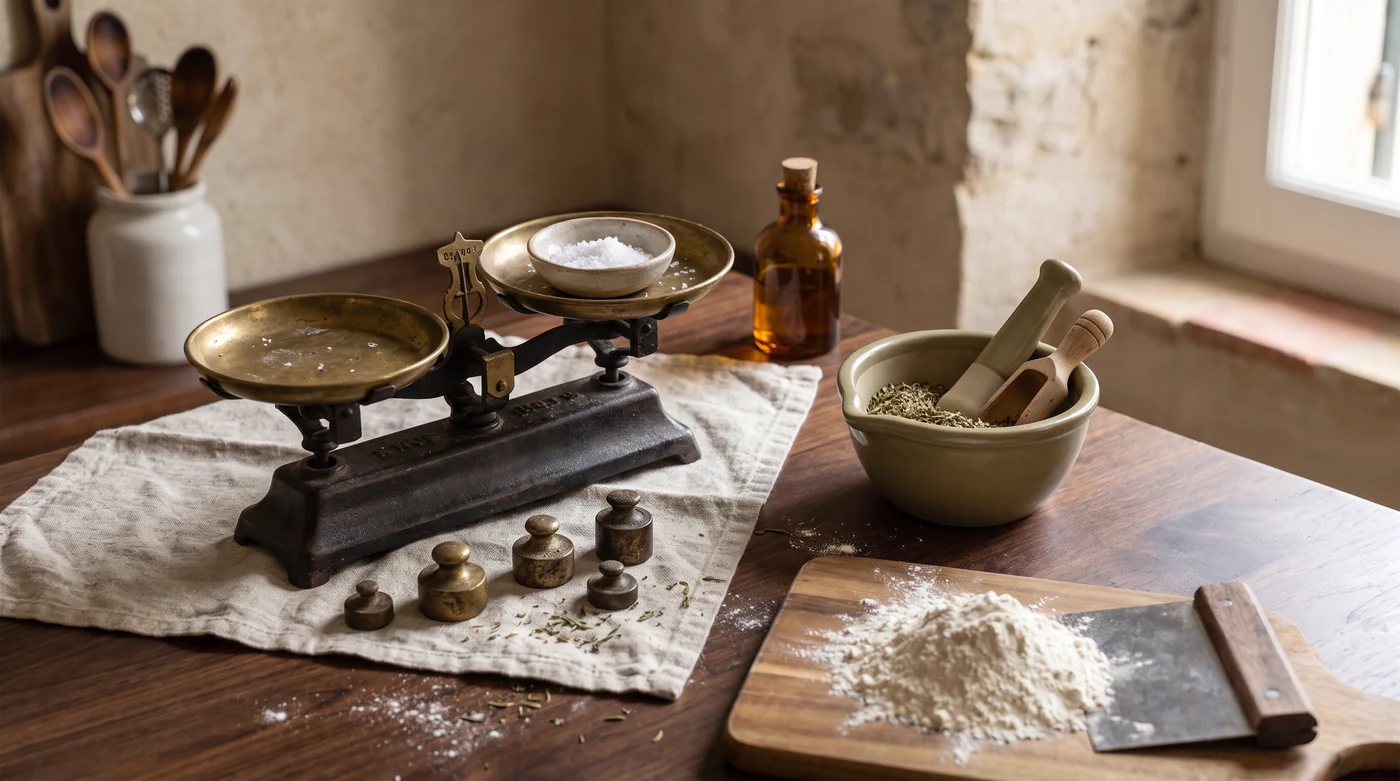
A general kitchen scale and a small-dose scale solve different problems. The OXO 11 lb model, for example, specifies 1 g metric increments. That is a useful specification to compare, but it does not mean a 0.4 g yeast amount can be weighed accurately on it. Match the amount to the instrument.
Choose tools you can handle and put away.
For a knife, compare the handle fit, blade length and the maintenance you are prepared to arrange. There is no need to begin with every blade in a block. A board must fit the worktop, sink and storage space, and stay stable during use. Check the maker’s cleaning advice for each material.
A peeler, flexible spatula, tongs or bench scraper can be inexpensive additions with clear jobs. Keep duplicate single-purpose tools out of the drawer until you know which task needs them. If borrowing or trying a tool is possible, note the fit in your hand as well as the claimed features.
Build a preparation note.
For the next meal, write a tiny sequence: weigh, wash, cut, portion, cook. Mark which tools are needed twice and when they can be cleaned. This is a useful way to discover whether you need another bowl or simply a better order of work. Keep raw-food handling separate according to appropriate food-safety guidance.
Take this to the kitchen.
At the source
Original references consulted for this research edition. Manufacturer statements describe the named product; they are not our own test results.