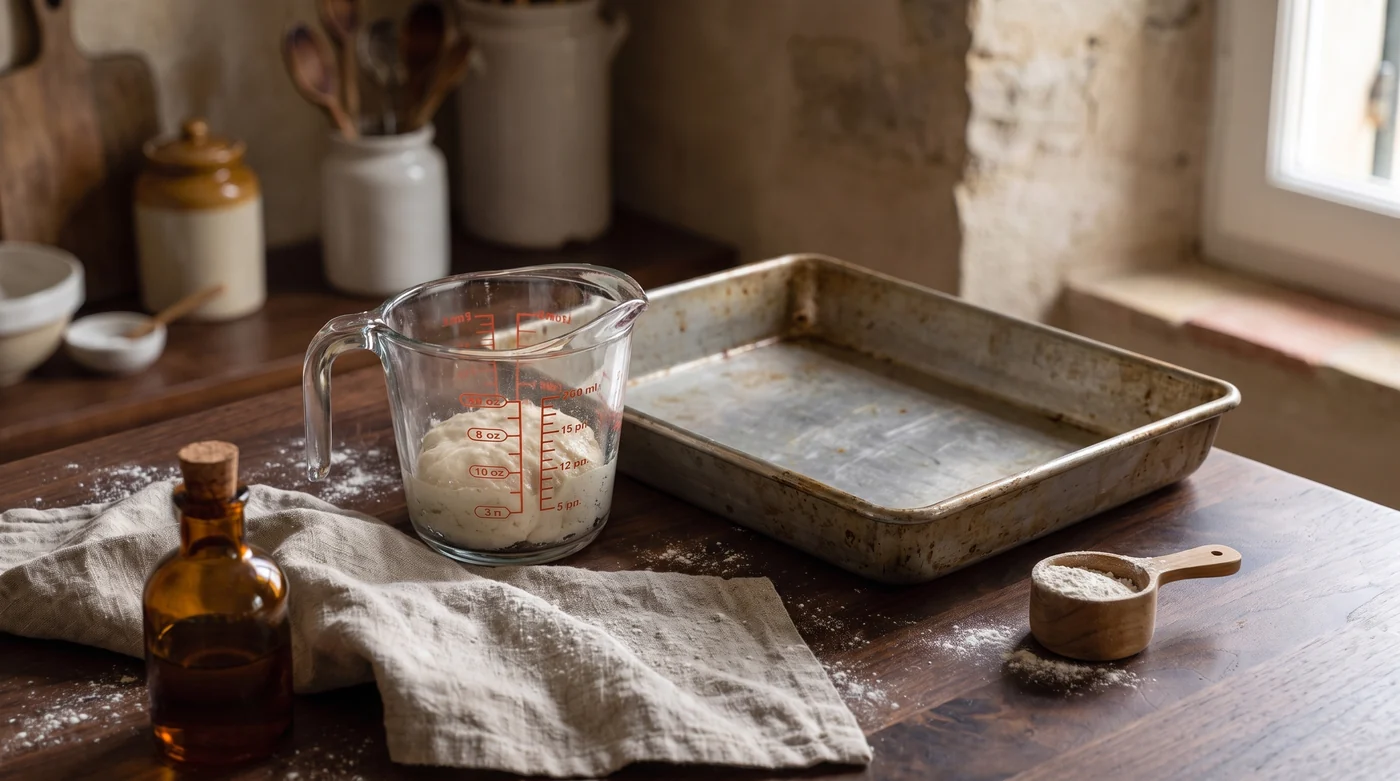
Measure inside, where the mixture sits.
Use the dimensions of the inside base, not the complete pan including rims and handles. Record the depth too. Rounded corners, tapered walls and decorative shapes complicate the comparison; the calculator models a flat rectangle or a circle. For anything more elaborate, use the manufacturer’s stated capacity and a recipe developed for that pan.
A round pan’s base area is π times its radius squared. A rectangular base is length times width. A 20 cm square has an area of 400 cm²; a 24 cm circle has an area of about 452.4 cm². The round base is about 1.131 times as large.
Decide whether the fill depth should stay similar.
If the goal is a similar depth in pans of compatible shape and construction, the area ratio offers a starting point for ingredient scaling. It is not a universal safe-fill rule. A batter or dough may expand, and the recipe may depend on a specific depth or support from the walls.
Our tool keeps original and replacement measurements separate and accepts centimetres or inches for either. It converts before comparing, so a measurement entered in inches is not accidentally treated as centimetres. The result is a multiplier, not a recommended number of minutes.
Review what the calculation leaves out.
Material, colour, wall shape and thickness can change how a pan behaves. The arithmetic does not account for these features. King Arthur Baking’s pan-size guidance discusses why changing the vessel can change the bake even when the ingredient amounts seem to fit.
Oven space matters as well. Check that the pan fits without preventing the clearances required by the appliance instructions. When splitting a recipe across several pans, consider the number that can be baked as directed. Do not assume every oven performs identically when filled with multiple trays.
Make a note that you can repeat.
Record the original recipe, both pans, the multiplier used and any ingredient rounding. Keep the recipe’s stated doneness checks and any required food-safety measurements in view. A timing change should be observed and documented rather than produced by multiplying the old time.
If the recipe is unusually sensitive or the new pan is radically different, finding a recipe for the pan you own may be the easier route. The calculator is most useful when it reveals the scale of a change before you commit to it.
Take this to the kitchen.
Open the Baking Composition tool ↗
At the source
Original references consulted for this research edition. Manufacturer statements describe the named product; they are not our own test results.